What is Hair Clay?
Ten years ago, if you walked into a barbershop and asked for clay, someone would have handed you a bucket and asked what you were building.
Now it’s the most-requested product on the shelf, and most people using it have no idea what’s actually in the tin.
Hair clay is a matte styling product built on a mineral clay — usually kaolin or bentonite. The clay does two jobs at once: the particles coat the hair to add grip and grit, and the mineral absorbs excess oil from the hair and scalp. That combination gives texture, volume, and a completely shine-free finish. Unlike most styling products, clay is buildable — the more you apply, the more hold you get, from loose texture right up to genuine structure.
That last part is the bit almost nobody mentions, and it’s the single most useful thing to understand about the product.
What hair clay is actually made of
The name is literal. There is real mineral clay in it.
Kaolin is a soft, fine, white clay — the same material used in porcelain. It’s mild, gently absorbent, and sits comfortably in a product you use every day. It absorbs excess oil without stripping.
Bentonite is a more absorbent volcanic clay. It swells when it meets moisture and pulls oil harder. That makes for a grippier, drier product — good for very oily hair, potentially too drying for everyone else.
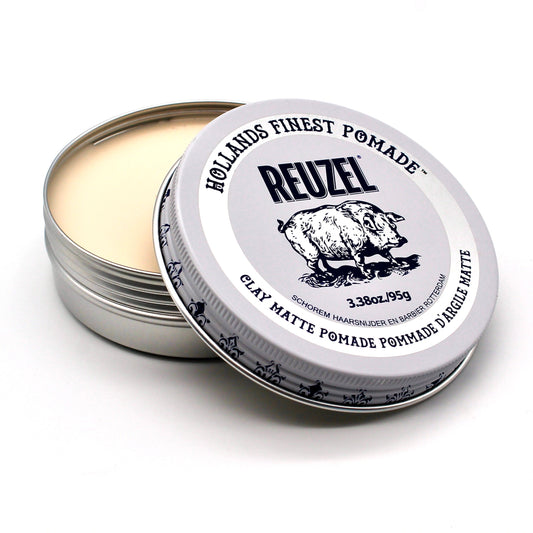
REUZEL makes one of each. Clay Matte Pomade is water-based, rated 6/10 hold and 1/10 shine, and built on kaolin clay alongside quinoa, aloe vera, and vitamin E, in a vanilla mint fragrance. It comes in 1.3 oz and 3.38 oz tins.
The bentonite one is Severed Head Strong Matte Clay Pomade, our collaboration with Liquid Death. Bentonite sits second on the ingredient list, right after water, which is why it hits harder than the kaolin formula: 8/10 hold, 0/10 shine, a gritty, piecey, genuinely zero-shine finish. It is also water-soluble, so it rinses out with a normal shampoo. Apple salsa fragrance, which is exactly as unserious as it sounds and exactly as good.
Two clays, two minerals, two jobs. Kaolin for everyday texture and volume on finer hair; bentonite when you want more grip, more grit and a harder matte.
Around the clay sits the rest of the formula: a water base so it rinses out with normal shampoo, waxes or polymers for hold, and conditioning agents to offset the drying tendency of the mineral. A clay that is only clay will give you texture and a straw-like finish. The supporting cast is what makes it wearable daily.
One point of terminology that confuses everybody: you’ll see “hair clay,” “clay pomade,” “matte clay,” and “styling clay” used interchangeably. They mean essentially the same thing. “Clay pomade” is a naming convention, not a different product — it signals a clay-based formula sold in a pomade format. REUZEL’s is called Clay Matte Pomade for exactly that reason.
What does hair clay do?
1. It adds texture and separation. Clay coats the strand and increases friction, so hair splits into defined pieces instead of moving as one flat sheet. That’s the entire look of the modern textured crop.
2. It creates volume. Absorbing oil at the root lets hair lift away from the scalp rather than lying down against it. Fine hair gets noticeably fuller.
3. It kills shine. Completely matte. Clay is what you use when you want your hair to look like hair, not like a product decision.
4. It absorbs oil. If your roots go greasy by mid-afternoon, clay buys you hours.
5. It makes hair look thicker. Two things happen at once: strands separate so they occupy more space, and the matte finish reflects less light, which reads visually as more density. This is an appearance effect, not a change to the hair itself — but it’s a real and useful one for fine or thinning hair.
6. It builds. A dime-sized scoop gives you loose, natural texture. Double it and you get structural hold. You can also reapply on top of an existing application later in the day. Very few styling products let you dial the strength without changing product.
How to use hair clay
Most clay disappointment is application error, not product failure.
The method
- Start with dry or towel-dried hair. REUZEL’s official guidance allows either, but understand the trade-off: completely dry hair gives the strongest matte grit and the most texture; slightly damp hair gives easier distribution and a softer, more natural result. Soaking wet hair dilutes the clay and wastes it.
- Take one to two knuckles’ worth from the tin. For short hair, less. You can always add.
- Emulsify it properly. Rub it between your palms until the clay disappears and your hands feel warm and evenly coated. Clay is stiffer than pomade and needs more working. This is the step that separates a good result from a clumpy one, and it’s the step most people skip.
- Start at the crown and work forward. Get it in at the roots first — that’s where the volume comes from — then work down toward the ends. Applying front-first gives you a heavy fringe and a bare crown.
- Shape with your fingers, pushing hair up and back. Use a comb only if you want a cleaner part or a more structured shape.
- Add more if you need more. Build in stages.
How much
Less than you think, then build. The two failure modes are opposite and both common: too little and you feel nothing and conclude clay doesn’t work; too much and you get a heavy, occasionally chalky result — and on dark hair, an over-applied clay can leave a faint visible cast.
Start with a dime-sized amount for short hair, a bit more for medium. Add a second small scoop rather than starting large.
Who hair clay is for
Clay is right for you if: - Your hair is fine, flat, or lacks body - Your roots go oily during the day - You want texture with no shine at all - You wear a textured crop, French crop, messy quiff, or casual side part - You want a “no product” look that still holds - You finger-style rather than comb
Look elsewhere if: - You want shine, slickness, or a polished finish — that’s water-based pomade. See hair clay vs pomade vs wax - Your hair is very dry or damaged — clay’s oil absorption works against you - Your hair is very long — clay is hard to distribute through length - Your hair is thick, coarse, and genuinely stubborn — a medium kaolin clay may not be enough, and a bentonite clay like Severed Head is the better starting point
 Hair clay by style
The textured crop. Clay’s home turf. Dry hair, small amount, worked in at the roots, pushed forward and tousled. Nothing else gets that look as cleanly.
The messy quiff. Blow-dry the front up first with Grooming Tonic, then clay to lock the height in without adding weight or shine.
The casual side part. Clay through damp hair, comb the part in, then break it up with your fingers so it reads relaxed rather than formal.
The grown-out fringe. Small amount through the ends only. Separation without stiffness.
What clay won’t do: a slick back, a proper pompadour, or anything that needs a comb to glide and a surface to shine. Clay fights the comb. That’s pomade territory.
Is hair clay bad for your hair?
No. Hair clay doesn’t damage hair. It’s a topical product sitting on the outside of the strand, and a water-based clay rinses out with normal shampoo.
Two real considerations, both manageable:
It can be drying. That’s the mechanism, not a defect — clay absorbs oil, and oil absorption is how you get volume and matte finish. If your hair already runs dry, use less, use it less often, and condition properly. A clay formulated with conditioning agents is easier to live with daily than a bare mineral formula.
Buildup at the scalp. Daily clay plus infrequent thorough cleansing means clay plus sebum plus hold agent accumulating at the root. That can feel coated or itchy. One proper cleanse a week clears it.
Does hair clay cause hair loss? No. There’s no mechanism by which a topical styling clay causes hair to fall out. Clay is, in fact, one of the products most often recommended for fine or thinning hair, because it creates the appearance of fuller hair without weighing it down. If you’re seeing genuine shedding, that’s a conversation with a doctor or trichologist, not a product swap.
Can you use it every day? Yes, if it’s water-based and you cleanse properly. REUZEL’s rinses out with a normal shampoo.
How to wash hair clay out
Water-based clay comes out with your regular shampoo. No special process.
If you use it daily, a deeper cleanse once or twice a week keeps the scalp clear. Follow with conditioner — clay’s whole job is absorbing oil, and you want to put some moisture back.
Oil-based clays and waxes are a different matter and need a proper degreasing method. Ours doesn’t — but if you’re layering clay over one of our oil-based greases, the degreasing guide covers it.
Layering: getting more out of clay
Grooming Tonic → blow-dry → clay. The standard barbershop volume build. Grooming Tonic into damp hair, blow-dry the roots up, then clay to lock it. Best routine available for fine hair that won’t hold height.
Salt spray → blow-dry → clay. Surf Tonic Sea Salt Spray builds all-over grit and body, clay adds shape and hold on top. More texture, less structure.
Clay → texture powder. Clay through the lengths for shape, Matte Texture Powder at the roots for lift. Maximum volume, still fully matte. More on that in what is texture powder.
Hydrating Styling Cream → clay. For dry or coarse hair. The cream puts moisture in first so the clay’s absorption doesn’t take the hair too far.
Five mistakes people make with hair clay
Not emulsifying it. Clay straight from tin to head lands in one spot as a lump and stays there. Warm it in your palms until it vanishes.
Using too much. Heavy, chalky, occasionally visible on dark hair. Start small.
Using too little and giving up. It builds. If nothing happened, add more.
Applying to soaking wet hair. Dilutes the clay and kills the matte effect. Damp at most, dry for maximum texture.
Fighting your hair type. Very long or very dry hair is not clay’s job. Use a paste or a cream instead and stop blaming the product.
 FAQ
FAQ
What is hair clay? Hair clay is a matte styling product built on a mineral clay, usually kaolin or bentonite. The clay coats the hair to add grip and texture while absorbing excess oil, producing volume and a completely shine-free finish. It is buildable, meaning hold increases with the amount applied.
What does hair clay do to your hair? It adds texture, separation, and volume, absorbs excess oil at the root, and delivers a matte, no-shine finish. Because separated strands occupy more space and a matte surface reflects less light, clay also makes hair look thicker and denser than it is.
How do you use hair clay? Take a small amount, emulsify it fully between your palms until it disappears, then work it into dry or towel-dried hair starting at the crown and moving forward. Get it in at the roots first for volume, then shape with your fingers. Build with a second small application if you need more hold.
Is hair clay the same as clay pomade? Effectively yes. “Clay pomade” describes a clay-based formula sold in a pomade format, and the terms are used interchangeably across the category. What matters is the base ingredient and the finish, not the word on the tin.
Is hair clay good for fine or thinning hair? It is one of the best options available. Most styling products add weight, which flattens fine hair. Clay adds grip and structure with very little weight, and the matte finish creates the appearance of greater density.
Is hair clay bad for your hair? No. It sits on the outside of the hair and a water-based clay rinses out with normal shampoo. The two things to manage are dryness, since clay absorbs oil by design, and scalp buildup with heavy daily use. Both are handled by using less and cleansing thoroughly once or twice a week.
Does hair clay cause hair loss? No. There is no mechanism by which a topical styling clay causes hair to fall out. It is frequently recommended for fine or thinning hair because it creates the appearance of fuller hair without added weight.
Can you use hair clay every day? Yes, provided it is water-based and you shampoo and condition regularly. If your hair runs dry, use less product and consider alternating with a cream or paste.
Should you use hair clay on wet or dry hair? Dry hair gives the strongest matte texture and grit. Towel-dried, slightly damp hair distributes more easily and gives a softer, more natural result. Avoid soaking wet hair, which dilutes the clay.
Does hair clay work on curly hair? It can, but with care. Clay absorbs oil, and curly hair generally needs moisture retained. Use a lighter hand, layer it over a leave-in or hydrating cream, or use a clay spray format, which distributes more easily through curls.
What’s the difference between kaolin and bentonite clay in hair products? Kaolin is a fine, mild clay that absorbs oil gently and suits regular use and finer hair. Bentonite is more absorbent and produces a drier, grippier result, which suits very oily hair and anyone wanting a harder matte. REUZEL makes one of each: Clay Matte Pomade is kaolin-based at 6/10 hold, and Severed Head Strong Matte Clay Pomade is bentonite-based at 8/10.
The REUZEL take
Clay is the closest thing grooming has to an honest product. It doesn’t shine, it doesn’t announce itself, and when it’s working properly nobody can tell you used anything.
Small amount. Warm it in your hands until it disappears. Roots first. Build.
Shop Clay Matte Pomade → Shop all hair styling products → Shop bestsellers →