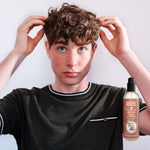
Best sea salt spray for men
The best sea salt spray for you depends on one thing: your hair type. For fine or straight hair, choose a light, high-salt formula that maximises grit and volume. For thick or wavy hair, choose one with conditioning agents so it doesn’t dry the hair out. For curly hair, most salt sprays are the wrong product — use a hydrating cream instead. REUZEL’s pick across the widest range of hair types is the Surf Tonic, a salt spray with conditioning agents that adds texture and volume without leaving hair crunchy.
Below: what actually separates a good salt spray from a bad one, matched to hair type, plus the honest limits of the category.
Straight up: this is REUZEL’s own guide and we make a salt spray. We’ve written it so it’s still useful if you buy someone else’s — the criteria section is the part that matters, and it applies to every product on the shelf.
What makes a sea salt spray good
Four things. Everything else is packaging.
1. The salt-to-conditioner ratio
Salt is what creates texture. It draws a small amount of moisture out of the hair shaft and leaves mineral deposits on the surface, which increases friction between strands. More friction means more grip, more separation, more apparent volume.
The catch is that the mechanism that creates texture is mildly drying. A formula that is nothing but salt and water gives you excellent grit and hair that feels like straw by week three.
What to look for: a formula that names conditioning or humectant ingredients alongside the salt. What to avoid: a product where salt or magnesium sulphate sits at the top of the list with nothing softening below it.
2. The spray mechanism
Undersold and genuinely important. A fine, wide mist distributes evenly across the head. A coarse jet dumps product in one spot, which is how you end up with a stiff patch above one ear and nothing anywhere else.
If you can test it in a shop, spray it at your palm from about eight inches. You want a cloud, not a stream.
3. Whether it flakes or goes crunchy
Cheap salt sprays leave a visible residue when they dry and feel stiff to the touch. A good one dries to a matte, gritty finish that still moves. This is almost entirely down to the conditioning system and the salt concentration.
4. Whether it’s honest about what it does
Salt spray adds grit, volume, separation and matte finish. It does not create curl in straight hair. Any product marketed on before-and-after photos going from poker-straight to beachy waves used a curling iron somewhere in the process. A brand that overclaims here will overclaim elsewhere.
Best sea salt spray by hair type
Fine or thin straight hair — prioritise lightness
Fine hair is where salt spray performs best and where the wrong choice does the most damage. You need volume, and you need the product to weigh nothing.
Look for: a light, watery formula with a fine mist. Alcohol low or absent. Avoid: anything described as “texturising cream spray” or containing oils — they’ll flatten you. Technique: spray at the roots on damp hair, then rough-dry with your fingers or a hairdryer on low. Air drying alone gives you about half the volume.
Thick or coarse straight hair — prioritise conditioning
You have plenty of body already. What you want is separation and matte finish, and your hair can take the drying effect less well than you’d think.
Look for: a formula with clearly named conditioning agents. Avoid: high-alcohol formulas. Technique: apply to damp hair mid-length to ends, less at the root.
Wavy hair — the best-case scenario
This is the hair type salt spray was made for. You already have a wave pattern; salt spray tightens and defines it.
Look for: a balanced formula. Almost anything decent works. Technique: apply to damp hair, scrunch upwards with your palms, leave it alone while it dries. Do not comb it.
Curly and coily hair — mostly the wrong product
Honest answer: most curly hair does not need salt spray. The problem curly hair has is dryness, and salt is drying. You will get definition at the cost of moisture, and it’s usually a bad trade.
Better options: a hydrating cream or a curl cream on wet hair. See our curly hair guide. If you still want grit: use it sparingly on mid-lengths only, never at the root, and always over a leave-in conditioner.
Color-treated or chemically processed hair — use with restraint
Salt accelerates color fade and processed hair is already compromised. Cap it at two or three uses a week and always condition.
The REUZEL pick
REUZEL Surf Tonic Sea Salt Spray is our salt spray. It’s built around the trade-off described above — enough salt to deliver real grit and volume, with conditioning agents so daily use doesn’t leave hair dry or crunchy. It’s a light formula with a fine mist, which makes it a sensible default across fine, thick and wavy hair.
It’s the right choice if: you want texture and volume on straight or wavy hair, you’re styling on damp hair, and you want a matte finish.
It’s the wrong choice if: you have tight curls (use a hydrating cream), you want shine (use a pomade), or you want a locked, all-day structured shape (use a clay or a matte pomade).
We’d rather you bought the right product than our product. Those are often the same thing, but not always.
How to use it properly
Most complaints about salt spray are technique problems, not product problems.
- Start with damp, towel-dried hair. Not soaking, not dry. This is the single biggest variable.
- Spray from about eight inches, evenly across the head. Four to eight pumps for short hair, eight to twelve for medium.
- Scrunch or rough-dry. Use your hands. Air drying alone gives a softer, weaker result.
- Don’t comb it. A comb undoes the separation you just built.
- Layer if you need hold. Salt spray is a pre-styler. A paste or clay on top gives you grip; the spray gives you the texture underneath it.
For the full mechanism and a section on what to realistically expect, read what does sea salt spray do.
The two most common mistakes
Using too little and concluding it did nothing. Salt spray needs more product than people expect, and most of its effect appears as the hair dries. If you judge the result while it’s still damp, you’ll assume it failed.
Using it daily on dry or damaged hair. Three or four times a week is a sensible ceiling if your hair is dry, colored, or chemically treated. Every day is fine on healthy hair with a conditioning formula and a decent conditioner in the routine.
Frequently asked questions
What is the best sea salt spray for men?
The best one for you depends on hair type. Fine or straight hair needs a light, high-grit formula; thick and wavy hair needs conditioning agents to offset the drying effect; curly hair is usually better served by a hydrating cream. REUZEL’s Surf Tonic is formulated to work across fine, thick and wavy hair with conditioning agents included.
Does sea salt spray work for men with straight hair?
Yes, for volume, grit and matte separation — but it will not create waves in genuinely straight hair. Expect fullness and texture, not curl.
Is sea salt spray bad for your hair?
Salt is mildly drying, which is inherent to how it creates texture. A formula with conditioning agents, sensible frequency, and a conditioner in your routine makes daily use fine for most people. If your hair is dry, colored or processed, cap it at three or four times a week.
How often should you use sea salt spray?
Daily is fine for healthy hair with a conditioning formula. Three to four times a week for dry, colored or chemically treated hair.
Should I put sea salt spray on wet or dry hair?
Damp, towel-dried hair. Soaking wet dilutes it; fully dry gives a weaker, patchier result.
Can you use sea salt spray with other products?
Yes, and you should. Salt spray works as a pre-styler — apply it first on damp hair, let it dry, then add a paste, clay or powder for hold on top.
Does sea salt spray cause hair loss?
No. Salt spray works on the hair shaft, not the follicle. It can make dry hair more prone to breakage if overused without conditioning, but that is breakage, not loss.
Compare the full styling range in REUZEL hair styling products, or see the bestsellers.