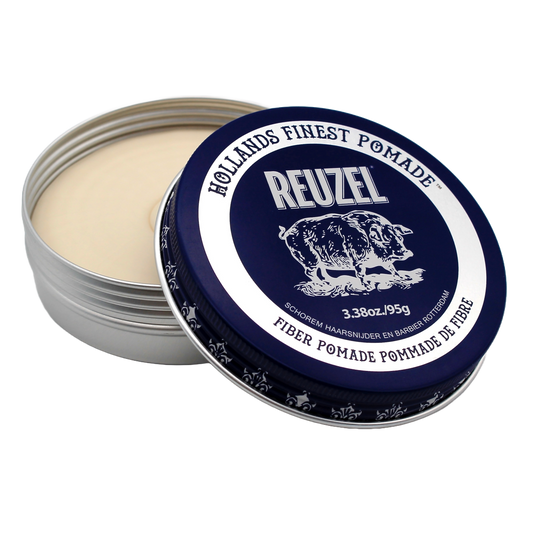
What is hair fiber
Search “hair fiber” and you’ll get three completely different answers, which is why nobody can give you a straight one.
So let’s start by working out which one you actually want.
“Hair fiber” means three different things. In styling, a fiber is a product — pomade, gel, cream or paste — containing fibrous polymers or waxes that stretch into fine strands and bridge between hairs, creating separation, texture and the appearance of thickness. In hair-loss cosmetics, “hair building fibers” are keratin powders sprinkled onto thinning areas to conceal the scalp. In trichology, the “hair fiber” is the scientific name for a single strand of hair itself.
If you’re standing in front of a shelf holding a tin labeled Fiber Pomade, you want the first one. Most of this article is about that. The other two get answered properly further down, because if you landed here looking for those, you deserve a real answer rather than a bounce.
The three meanings, quickly
| Meaning | What it is | Who’s asking | Do we sell it? |
|---|---|---|---|
| Styling fiber | A pomade, gel, cream or paste containing fibrous polymers that create texture and separation | Anyone choosing a styling product | Yes — three products |
| Hair building fibers | Keratin powder that clings to existing hair to conceal thinning areas | Anyone dealing with visible thinning | No — see the honest section below |
| The hair fiber | Anatomical term for a strand of hair: cuticle, cortex, medulla | Students, trichologists, ingredient researchers | N/A |
Styling fiber: what it actually is
A fiber styling product is one built around fibrous hold agents — polymers, silica, or specific waxes that behave differently from the smooth emulsions in a cream or the mineral grit in a clay.
Here’s the tell. Take a small amount of a genuine fiber product, rub it between your finger and thumb, then pull them apart. You’ll see fine, stringy, web-like strands stretch between them. That’s the fiber structure, and it’s not a gimmick — it’s the mechanism.
Why that matters in the hair: those strands physically bridge between individual hairs. Instead of coating each strand individually, a fiber product connects them to each other. The result is separation and structure: defined pieces that hold their shape, standing apart rather than clumping or lying flat.
That bridging effect is also why fiber products create the appearance of fuller hair. More strands held apart, occupying more space, catching light differently. REUZEL Fiber Pomade contains silica for exactly this reason — it creates the appearance of thicker, fuller hair.
What styling fiber does
- Separation and definition — the defining property. Pieces, not sheets.
- Texture without grit — clay gives you dry, sandy texture. Fiber gives you defined, springy texture.
- Volume and the appearance of fullness — strands held apart from each other.
- Firm hold that stays reworkable — fiber holds well but doesn’t set hard. You can rework it at 4pm.
- Low shine — natural, not matte and not glossy. Fiber sits between clay and pomade on finish.
- What it won’t do: produce mirror shine, hold a rigid slick back, or give the dry, chalky matte of a clay. Fiber is texture with structure.
The three REUZEL fiber products
| Product | Format | Hold | Shine | Best for |
|---|---|---|---|---|
| Fiber Pomade (Navy tin) | Tin, water-based | Firm / flexible, 8/10 | Low, 3/10 | The default. Texture, volume and separation on most hair types |
| Fiber Hair Gel | Tube, $16.50 | Strong / flexible | Low | Gel-level structure without crunch, flakes or stickiness |
| Fiber Cream | Tube, $17.50 | Medium, flexible | Low | Short to medium hair wanting softer, defined texture |
Which one
“I want the classic textured, separated look.” → Fiber Pomade. Vanilla mint, beeswax and silica, firm 8/10 hold that stays reworkable all day. This is the one most people mean.
“I want gel-strength hold but gel ruined my hair in 2003.” → Fiber Hair Gel. Alcohol-free, non-flaking, non-sticky, and the fibers give firm hold with genuine pliability instead of the shellac effect. Vegan, subtle sugary rum.
“I want texture but something lighter and more forgiving.” → Fiber Cream. Medium, flexible hold, low shine, best on short to medium lengths.
Layering them works. REUZEL’s own guidance: apply Fiber Cream to damp hair, then layer Fiber Pomade over the top for more defined texture.
One real compatibility note: Surf Texture and Definition Cream is not intended to be used with REUZEL Fiber products. Layer it with Matte Styling Paste or Clay Matte Pomade instead. That’s a formulation constraint, not a preference.
How to use hair fiber
The technique that matters is the same for all three formats: emulsify properly, then build the shape from underneath.
Fiber Pomade (tin)
- Dry or towel-dried hair. Dry gives more texture and separation; damp gives easier distribution and a softer result.
- Take a small amount — roughly a fingertip’s worth for short hair.
- Emulsify between your palms until it goes stringy and then thin. Fiber products need more working than a cream. Under-emulsified fiber lands in clumps and stays there.
- Work from the back and underneath first, then the crown, then the front. Get it in at the roots for lift.
- Shape with your fingers, not a comb. A comb flattens the separation you just built.
- Rework whenever you like through the day — fiber doesn’t set hard.
Fiber Gel (tube)
- Damp hair for maximum hold and even spread.
- Small amount, emulsify, distribute evenly through the whole head.
- Shape, then blow-dry if you want height and structure.
- It dries to a firm but flexible hold. No crunch, so don’t wait for it to set — it won’t.
Fiber Cream (tube)
- Damp or dry hair, distributed evenly from scalp to ends.
- Style with fingers.
- Layer Fiber Pomade over the top if you want more definition.
How much
Less than you think. Fiber is concentrated and it builds. Overapplication doesn’t go crunchy the way gel does — it goes heavy and flat, which is the opposite of the point.
| Texture type | Hold | Shine | Reworkable | Best for | |
|---|---|---|---|---|---|
| Fiber | Defined, springy, separated | Firm, flexible | Low | Yes | Texture with structure |
| Clay | Dry, gritty, matte | Medium–strong | None | Somewhat | Matte volume, fine hair |
| Paste | Soft, flexible | Medium | Low | Yes | Medium-length, flexible looks |
| Cream | Smooth, controlled | Light–medium | Low, natural | Yes | Frizz, fine hair, natural finish |
| Pomade | Smooth, combable | Medium–strong | Low–high | Yes | Slick backs, pomps, side parts |
| Gel | Set, structured | Strong | Varies | No | Rigid styles |
Fiber vs clay is the comparison people actually mean. Clay absorbs oil and gives a dry, sandy, fully matte texture — best on fine hair that needs volume. Fiber bridges between strands and gives springy, defined separation with a little more hold and slightly more shine — best when you want structure and pieces rather than dryness. Fine, flat hair often does better with clay. Hair that has body but no shape usually does better with fiber.
Full breakdown across formats in hair clay vs pomade vs wax, and cream specifically in how to use hair styling cream.
Who styling fiber is for
Reach for fiber if: - You want visible texture and separation — defined pieces, not a smooth sheet - Your hair is short to medium with a textured crop, quiff, or messy style - You want firm hold that you can still rework during the day - You want the appearance of fuller hair without a heavy product - You liked gel’s hold but not its crunch - Your hair is normal to thick and holds a shape but lacks definition
Look elsewhere if: - You want shine or a slick, combed finish — pomade - You want dry, chalky matte — clay or texture powder - Your hair is very fine and flattens easily — start with clay or powder - Your hair is frizzy or dry and needs conditioning — cream
“Hair building fibers” — the honest answer
If you came here about thinning hair, this is the section you wanted, and we’ll be straight with you.
Hair building fibers are not a styling product. They’re finely milled keratin particles, usually carrying a static charge, that you sprinkle or spray onto thinning areas. The particles cling to your existing hairs, and because they’re the same color and material as hair, they visually fill the gaps and hide scalp. The effect is instant and it’s purely cosmetic — it lasts until you wash it out.
What they do: conceal visible thinning and scalp show-through, immediately.
What they don’t do: anything to your actual hair. They don’t grow hair, don’t slow loss, and don’t treat the underlying cause. Any brand telling you otherwise is selling you something.
REUZEL doesn’t make hair building fibers, and we’re not going to pretend a styling product is a substitute. They’re two different categories solving two different problems.
What we do offer for the appearance of thinning hair are styling products that make the hair you have look denser:
- Fiber Pomade — silica creates the appearance of thicker, fuller hair, and the separation effect adds visual density
- Matte Texture Powder — weightless root lift; most volume products add weight, which is exactly what fine or thinning hair can’t take
- Spray Grooming Tonic — blow-dry foundation for genuine lift at the root. It is 30% lighter than the original Grooming Tonic and built for finer hair; the heavier tonic is easy to overdo on fine hair and can read as greasy
Our full guidance is in The Best Men’s Hair Products for Thinning Hair.
If you’re experiencing genuine, progressive hair loss, no styling product is the answer to that — a doctor, dermatologist or trichologist is. Concealing it and treating it are different projects, and it’s worth doing both properly.
The hair fiber, in the anatomical sense
Briefly, because it’s the third meaning and it’s the one that shows up in ingredient research.
A hair fiber is a single strand of hair. It’s made almost entirely of keratin, a sulfur-rich protein, and has three layers:
- The cuticle — the outer layer, made of flat overlapping scales. It protects everything beneath it and reflects light, which is where shine comes from. Smooth cuticle reads as healthy and shiny; lifted or damaged cuticle reads as dull and frizzy.
- The cortex — the bulk of the strand. It holds the pigment and provides strength and elasticity.
- The medulla — the central core, not present in every hair type.
This is worth knowing for one practical reason: most styling products work on the cuticle. Clay lifts it slightly to create grit. Salt spray does the same. Cream smooths it flat to reduce frizz. Fiber products largely bypass it and work between strands instead. That’s why fiber feels different in the hair from everything else.
Four mistakes people make with fiber products
Not emulsifying enough. Fiber needs more working between the palms than cream or pomade. Rub until it’s gone stringy and then thin. Clumps come from skipping this.
Combing it out. Fiber’s whole benefit is separation. A comb destroys it. Fingers only.
Using too much. It builds, and overapplication goes heavy and flat rather than crunchy — which is harder to spot until your hair has already dropped.
Expecting matte. Fiber is low shine, not no shine. If you want fully matte, that’s clay or texture powder.
FAQ
What is hair fiber?
The term has three meanings. In styling, a fiber is a product containing fibrous polymers or waxes that stretch into fine strands and bridge between individual hairs, creating separation, texture and the appearance of thickness. In hair-loss cosmetics, hair building fibers are keratin powders sprinkled onto thinning areas to conceal the scalp. In trichology, the hair fiber is the anatomical term for a single strand of hair.
What does fiber do in a hair product?
Fibrous hold agents form fine strands that physically bridge between hairs rather than simply coating each one. That connects strands to each other, producing defined separation, springy texture, firm but reworkable hold, and the appearance of greater fullness.
How do you use hair fiber?
Take a small amount and emulsify it thoroughly between your palms until it goes stringy and then spreads thin. Work it through dry or towel-dried hair from the back and underneath first, then the crown and front, getting it in at the roots for lift. Shape with your fingers rather than a comb, since combing flattens the separation.
What’s the difference between fiber and clay?
Clay absorbs oil and produces a dry, gritty, fully matte texture, which suits fine hair needing volume. Fiber bridges between strands and produces springy, defined separation with slightly more hold and slightly more shine, which suits hair that has body but lacks shape.
Is fiber pomade good for thin hair?
It can help the appearance of thin hair, because the separation effect and ingredients such as silica create the look of greater density. However, very fine or flat hair often does better with a clay or a texture powder, which add volume with less weight.
Are hair building fibers the same as fiber styling products?
No. They are entirely different categories. Hair building fibers are keratin powders that conceal visible thinning by clinging to existing hair. Fiber styling products are pomades, gels and creams that create texture and hold. REUZEL makes the second, not the first.
Do hair building fibers work?
They conceal the appearance of thinning immediately and effectively, and the effect lasts until you wash it out. They do not grow hair, slow hair loss, or treat any underlying cause. They are a cosmetic concealer, not a treatment.
Is fiber gel better than regular gel?
For most people, yes. Traditional gels contain alcohol and set hard, producing crunch and flaking. A fiber gel uses fibrous hold agents to deliver comparable firm hold while staying flexible, and REUZEL Fiber Hair Gel is alcohol-free and non-flaking.
Can you use fiber products every day?
Yes. REUZEL’s fiber products are water-based or water-soluble and rinse out with a normal shampoo. As with any daily styling product, a thorough cleanse once or twice a week prevents buildup at the scalp.
Can you layer fiber products with other products?
Yes. REUZEL’s own guidance is to apply Fiber Cream to damp hair and layer Fiber Pomade over the top for more defined texture. One exception: Surf Texture and Definition Cream is not intended to be used with Fiber products.
What is the hair fiber made of?
A hair fiber is composed almost entirely of keratin, a sulfur-rich protein, arranged in three layers: the cuticle, an outer layer of overlapping scales that protects the strand and reflects light; the cortex, which carries pigment and provides strength and elasticity; and the medulla, a central core not present in all hair types.
The REUZEL take
Rub a bit between your fingers and pull them apart. If you see strands, that’s fiber, and that’s the whole idea — a product that connects your hair to itself instead of just coating it.
Emulsify properly. Roots first. Fingers, never a comb.